

Noora Lab Tech
Industrial DAQ with Built-In PID and Motion Control (NLDQ-1612-AI22)
Industrial DAQ with Built-In PID and Motion Control (NLDQ-1612-AI22)
Noora Industrial DAQ is a compact industrial platform that combines data acquisition, control, and communication in a single device. It provides analog and digital I/O, motion-control outputs for motors and drivers, built-in PID control, and communication interfaces for distributed systems.
Share

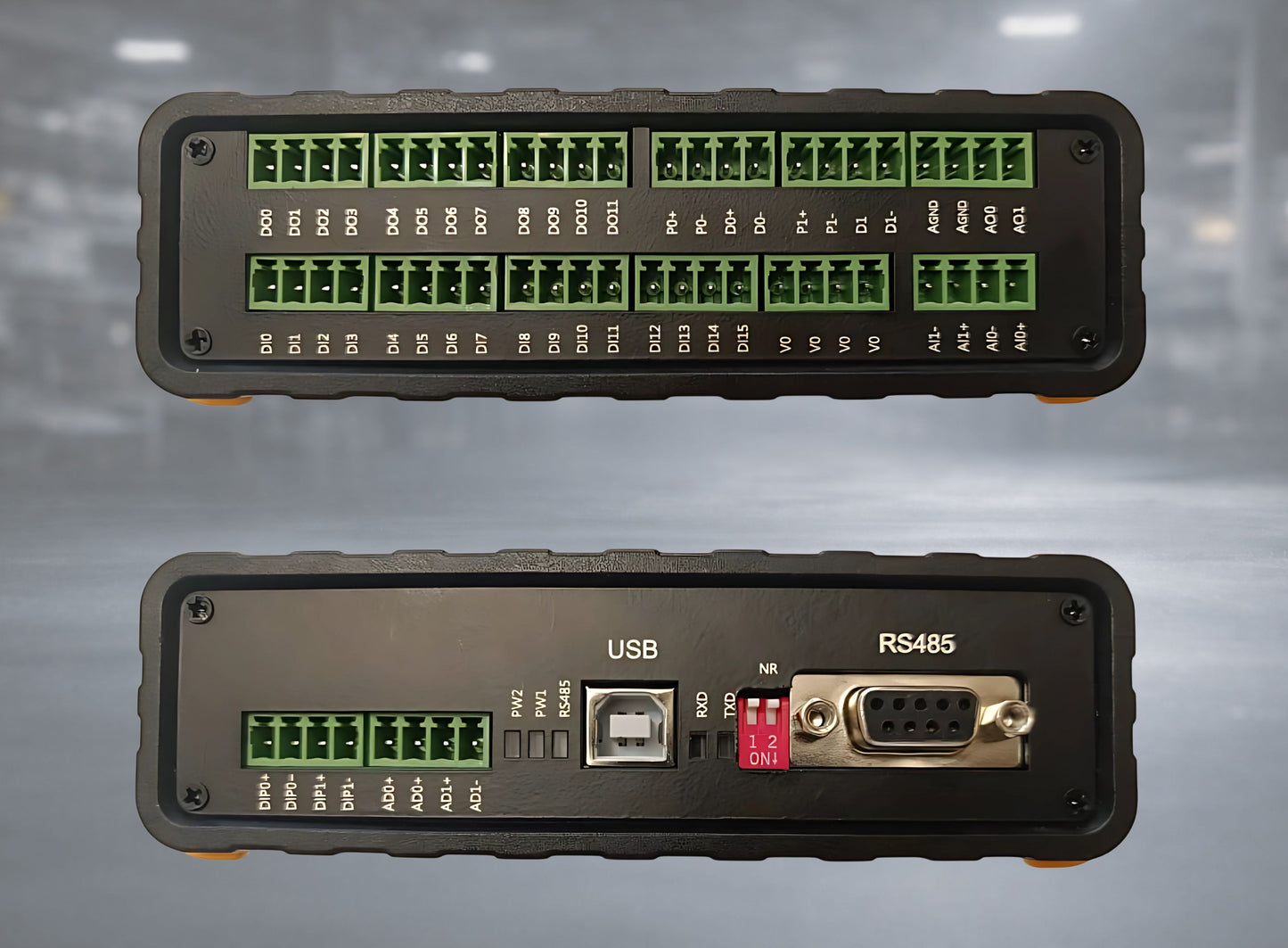
Three Key Features of Noora DAQ
1- Independent Power Lines for Enhanced Performance
- Noora DAQ features a dedicated power line separate from USB, ensuring stable operation.
- It includes separate digital and analog power inputs to eliminate noise, enhance isolation, and improve measurement accuracy.
2- Long-Distance Communication with RS485
- Equipped with an RS485 port, Noora DAQ supports reliable data transmission over distances of up to 100 meters, making it ideal for industrial automation and remote actuator control.
3- Motor Control with Dedicated PWM Outputs
- Noora DAQ includes 2 dedicated PWM channels within its I/O system, specifically designed for precise motor control, ensuring smooth operation in automation and motion control applications.
- Designed for engineers and developers building industrial-grade measurement and control systems.
Advanced Motor & Motion Control:
The device includes two configurable motion-control output channels that can operate either as high-frequency PWM outputs or as Pulse/Direction signals for stepper and servo motor driver control.
Each channel can be configured for:
- Standard 20 kHz PWM output for DC motor speed control and power electronics applications
- Pulse/Direction mode for driving external stepper or servo motor drivers
This flexibility enables seamless integration with a wide range of motion systems used in industrial automation, robotics, laboratory equipment, and custom control platforms.
- High-Resolution PWM: Up to 16-bit resolution for smooth and precise control
- High-Frequency Operation: Designed for reliable performance in demanding industrial environments
Wide Range of Applications:
- Motor Control: Stepper motors, servo systems, linear actuators, and positioning stages
- Custom Signal Generation: Motion platforms, automation systems, and test equipment
Current-Driven Output Stage for Long-Distance Signal Integrity:
Unlike standard MCU logic outputs, the Pulse and Direction signals are generated through a dedicated current-driven output stage. This design significantly improves signal robustness and allows motor drivers to be installed remotely from the DAQ unit.
Key advantages include:
- Reliable signal transmission over cable lengths of up to 10 meters
- Strong immunity to signal degradation caused by cable capacitance and industrial noise
- Each channel capable of driving signal lines with resistances up to 2 kΩ
- Reduced edge distortion and improved timing accuracy for Pulse/Direction control
This architecture enables flexible system layouts where motor drivers can be located closer to motors while the DAQ remains in a central control cabinet.
System Overview – Hardware:
Digital I/O
Digital Inputs: 16
Digital Outputs: 12
Logic Levels: 12 V or 24 V
Maximum Digital Update Rate: 5 kS/s
Analog Input
Number of Channels: 2 (Differential)
Resolution: 12-bit
Input Voltage Range: ±12 V
Maximum Sample Rate: 30 kS/s
Simultaneous Sampling: Yes
Analog Output
Number of Channels: 2
Resolution: 12-bit
Voltage Range: 0-12 V
Current Output: 250 mA per channel
Motion & Control
Dedicated PWM / Pulse-Direction Outputs
Built-in PID Control
Number of Counters/Timers: 1
Communication
USB 2.0 (Isolated)
RS485 (Isolated, DB9)
Power
Supported Input: 24 VDC, 3 A
Independent Digital and Analog Power Inputs
USB Bus Power: Not Used
Mechanical
Enclosure: Aluminum
Dimensions (L × W × H):
170 × 128 × 36 mm (6.69 × 5.04 × 1.42 in)
Collapsible content
Digital Inputs (16 Channels)
- Logic Levels: 12 V or 24 V
- Sampling Rate: Up to 10 kHz
- Protection: ±30 V input protection, 4 kV opto-isolation
- Current Draw: 10-20 mA (pull-down configuration)
- Input Polarity: Active High
- Input Type: Pull-Down configuration
Digital Outputs (12 Channels)
- Logic Levels: 12 V or 24 V
- High-Side Output: Up to 500 mA per channel
- Switching Speed: Up to 10 kHz
- Protection: Built-in clamp diodes and 4 kV isolation
- Integrated Pull-Down Resistor: 5.6 kΩ
Analog Inputs (2 Channels)
- Differential Measurement for improved accuracy
- Resolution: 12-bit
- Sampling Rate: 30 kS/s
- Input Voltage Range: ±12 V
- High Input Impedance: 1 MΩ
- Noise & Accuracy: ±2 LSB typical noise, ±0.2% FS accuracy
- Common Mode Rejection Ratio (CMRR): ≥110 dB
- Isolation: ±1.5 kV
- Input Protection: ±30 V protection against overvoltage
Analog Outputs (2 Channels)
- Voltage Range: 0-12 V
- Current Output: 250 mA per channel
- Resolution: 12-bit
- Update Rate: 30 kS/s
- Output Impedance: 1Ω
- Accuracy: ±0.12% FS
- Output Noise: 805 µV
- Isolation: ±1.5 kV
Built-in PID Control & Feedback System
- Analog Output Channels: 2
- Analog Feedback Inputs: 2 (differential)
- Feedback Signal Range: 0–12 V (differential)
- Adjustable Output Signal Range: 0–12 V
- Precision PID Tuning: Adjustable with 0.02 resolution for P, I, and D parameters
- Real-Time Control: Up to 1 kHz update rate
USB Interface: High-Speed & Multi-Platform Compatibility
- Acts as the primary communication interface for seamless connectivity.
- Data Transfer Rate: 1 Mbps.
- Driver Support: Compatible with ANSI C, Python, Visual C# .NET, Visual Basic .NET, and NI LabVIEW for easy software integration.
RS485 Communication: Reliable Industrial Protocols
- Maximum Bitrate: Up to 1 Mbps.
- Supported Protocols: Custom protocols (user-defined).
- Fully configurable for various industrial applications.
- The integrated RS485 interface allows multiple DAQ units to be networked together and controlled through a single shared communication bus.

This DAQ focuses on:
• Integration of measurement, control, and motion
• Operation in electrically noisy environments
• Simplifying real-world system design
The system was designed to handle real-world challenges.